My friends in The Savoy Ballroom needed some stage DI boxes for their numerous acoustic instruments. They wanted to be able to mute the signal whilst tuning up or switching instruments, so I build these nice little boxes for them.
They are based on Bo Hansen's easy to make design, but with added bells and whistles - well, a switch, a lamp and an extra output.
Job done - now back to recording!
2011/05/28
2011/05/22
Transformer assembly line!
This week we have been building lots of little transformer moxes to match vintage 30 ohm ribbon mics to modern mic preamps. Correct impedance matching can deliver a +12 dB increase in level without noise penalty or loss of frequency response, which is welcome for many older microphones. Here is how a Reslo RV microphone behaves with and without the transformer:
![]() |
| Frequency response plots for Reslo mic with and without an impedance matching transformer |
- Reslo RBL and RB 30 ohm models
- Melodium 42b
- Grampian ribbon mics (including GR1/L and GR2/L)
- Cadenza ribbon microphones (wired for low-Z use)
- RSA & Selmer ribbon mics
- STC 4033
- Altec and Western Electric ribbon microphones
More information.
2011/05/15
Mic of the month - Melodium 42b
Our Microphone of the Month for May is the magnificent Melodium 42B ribbon microphone.
![]() |
| Evolving Melodium 42b - serial no. in the 1700s, 4300s and 6600s (L to R) |
The Melodium 42B was conceived as a French alternative to the RCA 44 family of microphones, and is in its own way every bit as good as the more celebrated RCA mics. At 32 cm high and 14 cm wide, and weighing 2.65 Kg, the 42b is a huge microphone with a large ribbon (68 mm long by 4.2 mm wide) and big powerful magnets*, to give a strong output with low noise.
We have been lucky enough to have four of these through the workshop, and have had the opportunity to observe some for the finer details that have evolved during the production of these beauties. Over the years the grill of the 42b has been refined, with the holes becoming larger, and a solid unperforated band appearing across the bottom of the microphone. Later microphones have a three pin connector at the rear, whist early models are hard-wired.
The photo on the left shows the later style of magnets. The transformer and inductor are in the circular metal can below. Some models have a rectangular can, but the transformer and inductor inside are similar, at least in the ones we studied. The transformer has a ratio of 1:14, giving an output impedance of 50 ohms**
There is also a facility to adjust the ribbon tension, which should be mandatory on all ribbon mics!
Here's a short summary of the changes with serial number:
- 1500 - Small grill holes, fixed cable (no connector), U-magnets with North marked, rectangular transformer case
- 1700 - Small grill holes, fixed cable (no connector), U-magnets, circular transformer case
- 1900 - Small grill holes, fixed cable (no connector)r, U-magnets, square transformer case
- 3400 - Small grill holes, connector, U-magnets (unmarked), rectangular transformer case
- 3700 - Big grill holes, connector, U magnets, rectangular transformer case
- 4300 - Big grill holes, connector, U magnets, rectangular transformer case
- 5100 - Big grill holes, fixed cable (no connector), U-magnets, rectangular transformer case
- 5300 - Big grill holes, connector, U magnets, rectangular transformer case
- 6100 - Big grill holes, connector, U magnets (North is marked), rectangular transformer case
- 6600 - Big grill holes, connector, block magnets, circular transformer case
- 8000 - Big grill holes, connector, block magnets, circular transformer case
The latest serial number that I know of is number 9250, on the Coutant website, which has large grill holes and a connector.
Above is a frequency plot that I recorded in our anechoic mic testing chamber (well, more of a walk-in cupboard really!). This was recorded at 40 cm distance from the sound source, which is a concentric full range speaker, using a swept sine wave technique.
The bottom end boost due to proximity effect is pronounced, even at this distance, and the effect on the sound is very musical when capturing acoustic instruments. Of course sometimes you don't want or need the proximity boost, and the switch conveniently corrects for this at speaking and singing distances.
If you are lucky enough to come across an old Melodium 42b but are disappointed with the sound, it may well have an oxidised ribbon and will need cleaning. The strong magnets are prone to attracting little shards of iron, which stick to the magnets and interfere with free motion of the ribbon.
* It is worth noting that the magnets on these microphones can fade with time - a healthy 42b should have a magentic field between the pole pieces of around 4000 Gauss. One of our microphones measured at just 1500 gauss and it was necessary to replace the magnets with suitable modern alternatives. If you have a Melodium with a weak output it may be worth having the field measured and the ribbon checked. Xaudia can of course help with all those things.
** For optimum results with modern equipment a matching transformer is recommended.
Here are some Melodium links on the web:
- Mattéo and Axel at Infernale Machine studios in Beziers, France are both Melodium enthusiasts and there are some good photos and some information in French about servicing and cleaning these microphones on their website.
- George at Kore Studios is also a fan - here is a rather lovely song that was recorded at Kore using a 42b for vocals: East Wind by Ed Laurie.
- The original Melodium brochure is available to download from Professor Stan Coutant's excellent website.
Updated 9/10/14 with additional serial numbers
Read more about the Melodium 42B at MoMics, the Museum of Microphones.
Meazzi and Framez ribbon mics revisited
April's MOTM was a nice old Framez ribbon mic, and its chunky Meazzi sister also made an appearance. Here's the article... and here are the microphones:
I've had the opportunity to compare these in the anechoic box - here's how they look (click to enlarge).
The Meazzi has an overall flatter frequency response, but in both cases there is a significant peak around 4KHz, which should add attack to recorded percussion and clarity & presence to vocals. The Framez is slightly more sensitive in the mid range, but falls away somewhat below 150 Hz.
Whilst revisiting these mics, it is worth looking at the Meazzi's perforated backplate resonator, which contributes to the pickup pattern and frequency response.
(Nb. Both microphones were fitted with 1.8 micrometer ribbons and wired for low impedance.)
I've had the opportunity to compare these in the anechoic box - here's how they look (click to enlarge).
![]() |
| Frequency plots for Meazzi and Framez mics |
The Meazzi has an overall flatter frequency response, but in both cases there is a significant peak around 4KHz, which should add attack to recorded percussion and clarity & presence to vocals. The Framez is slightly more sensitive in the mid range, but falls away somewhat below 150 Hz.
Whilst revisiting these mics, it is worth looking at the Meazzi's perforated backplate resonator, which contributes to the pickup pattern and frequency response.
(Nb. Both microphones were fitted with 1.8 micrometer ribbons and wired for low impedance.)
2011/04/23
Summer is here, and it is Reslo season.
Another typical day at the Xaudia studio & workshop...
Outside the studio .... flowers, blue sky and cows.
And inside, in the basement workshop.... a Reslo production line!
We see a lot of these little British microphones. The original ribbons are quite thick and have an unusual 'square wave' corrugation. Very often these have oxidised and become noisy, and after 50 years they usually benefit from a clean and a fresh ribbon.
Outside the studio .... flowers, blue sky and cows.
And inside, in the basement workshop.... a Reslo production line!
We see a lot of these little British microphones. The original ribbons are quite thick and have an unusual 'square wave' corrugation. Very often these have oxidised and become noisy, and after 50 years they usually benefit from a clean and a fresh ribbon.
2011/04/14
Microphone of the Month - Framez ribbon microphone.
April's microphone of the month (MOTM) is this glamorous shiny blue ribbon microphone by Framez (not to be confused with Framus!)
This has no model or serial number, but is probably from later 1950s or early 60s. Framez were an Italian brand related to Meazzi - according to one source the name is a contraction of Fratelli Meazzi (trans. Meazzi Brothers), which does sound plausible. Framez / Meazzi also made some cool oddball guitars, and were associated with Wandré Pioli. Fetish guitars have much more information about these guitars.
Back to the microphone! This looks very much like a copy of the RCA 74b 'junior' microphone, but us physically somewhat smaller. And it is a pretty good microphone in its own right. The magnets have retained their strength over the years, measuring a healthy 4500 gauss between the pole pieces. It has a hefty transformer with taps for both low and high impedance, making it suitable for both recording and PA use.
This one arrived with a thick flat ribbon - probably a DIY 'kitchen foil' repair. With a proper 2.5 micrometer ribbon installed, and the mic rewired for balanced, low impedance operation, the sound is clear with a strong output, just lacking a little of the low end proximity boost that you find with many ribbon microphones. The 'low' impedance tap is 1:45 ratio, which gives around a 450 ohm output with the 2.5 micron ribbon.
I'm actually very impressed with this little microphone, and it looks great too!
Update 23/4/11
We managed to get hold of a Meazzi ribbon microphone for comparison. It's a little less glamorous, and has a similar ribbon dimensions, but a very different motor assembly.
This has no model or serial number, but is probably from later 1950s or early 60s. Framez were an Italian brand related to Meazzi - according to one source the name is a contraction of Fratelli Meazzi (trans. Meazzi Brothers), which does sound plausible. Framez / Meazzi also made some cool oddball guitars, and were associated with Wandré Pioli. Fetish guitars have much more information about these guitars.
Back to the microphone! This looks very much like a copy of the RCA 74b 'junior' microphone, but us physically somewhat smaller. And it is a pretty good microphone in its own right. The magnets have retained their strength over the years, measuring a healthy 4500 gauss between the pole pieces. It has a hefty transformer with taps for both low and high impedance, making it suitable for both recording and PA use.
This one arrived with a thick flat ribbon - probably a DIY 'kitchen foil' repair. With a proper 2.5 micrometer ribbon installed, and the mic rewired for balanced, low impedance operation, the sound is clear with a strong output, just lacking a little of the low end proximity boost that you find with many ribbon microphones. The 'low' impedance tap is 1:45 ratio, which gives around a 450 ohm output with the 2.5 micron ribbon.
I'm actually very impressed with this little microphone, and it looks great too!
Update 23/4/11
We managed to get hold of a Meazzi ribbon microphone for comparison. It's a little less glamorous, and has a similar ribbon dimensions, but a very different motor assembly.
Strange things you find inside mics, part 2
A few months ago I wrote this blog post about the strange things that I had seen inside ribbon microphones. In those cases the 'strange things' in question were put in there deliberately by previous owners or techs trying to repair or improve the microphone.
Since then I have come across a couple of microphones which contained even weirder things - insects!
Before modern foams, felted wool was widely used in microphones for shock mounts, wind shields and the like. Unfortunately, moths love this stuff too.
Since then I have come across a couple of microphones which contained even weirder things - insects!
Before modern foams, felted wool was widely used in microphones for shock mounts, wind shields and the like. Unfortunately, moths love this stuff too.
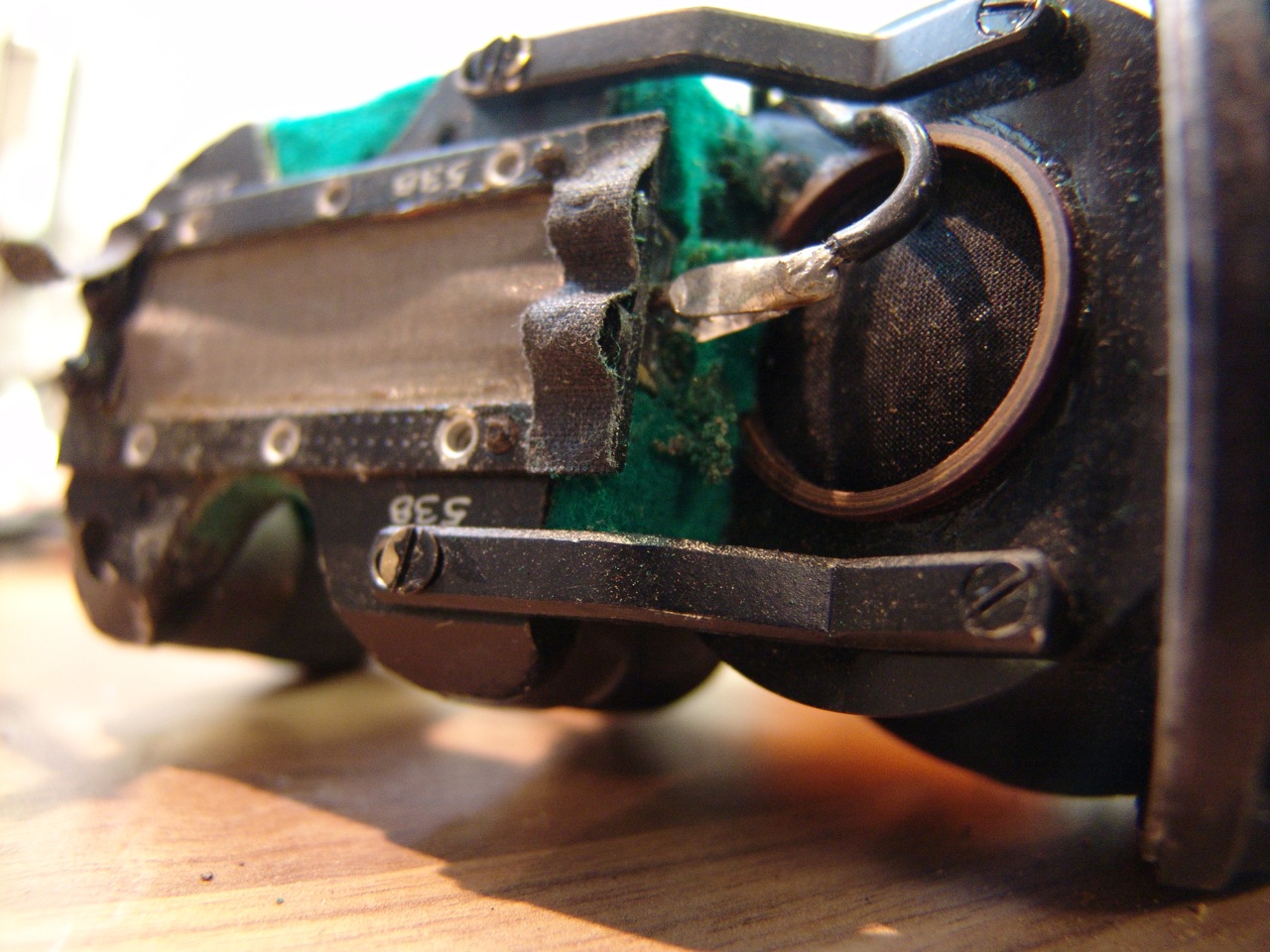
Here's an old STC4033. You can see the moth eggs on the lower block of green felt.
Worse still, one of the moths had become lodged behind the ribbon:
Moths also seem to like the wool lining and felt mounts on AKG D12s - here you can see the eggs and damage to the lining in the inside corner of the grill:
Anyway, I guess the lesson to be learned is that microphones should be stored in dry, clean places and not in the garage, or at the bottom of the wardrobe.
:-D
(thanks to Steve Parry )
2011/04/13
2011/03/31
MOTM: Shaftesbury Velodyne Supreme
The output of a ribbon mic will scale in proportion to the length of the ribbon, at least up to a point. The idea behind the Velodyne was to give increased output by using a super-long ribbon. Normally that wouldn't give you as high an output as it should, because of 'rippling', or other incoherent vibrational modes. But by fixing the ribbon in multiple places they claim to avoid this problem. The microphone was sufficiently novel at the time for the inventors to apply for protection.
I wonder how well it worked? Sadly we may never know. The ribbon is broken in many places, and is glued down, so it will net be an easy thing to replace. I'm still struggling over whether to try and get this working or not. I suspect it really ought to be left in its historic condition, but I am curious about how it would have sounded.
Postscript: History shows that this design was not a success. Whether this was for sonic or economic reasons, we can only speculate, but Shaftesbury appear to have abandoned the concept. Their later ribbon microphones were a much more conventional affair, like this Shaftesbury RT model - ribbon, magnets and transformer.
2011/02/22
Mic of the Month - Zephyr 30RA high impedance ribbon mic
February's MOTM is a ribbon microphone made by Zephyr, of Australia. It's nice to see a microphone that begins with the letter Z!
The mic has a very "retro sci-fi" look, with hammerite paint and a punched metal grill. The name plate reads "High fidelity velocity microphone type 30RA, but despite the misleading model number, the mic is actually a high impedance mode, and the output transformer is marked "50K'.
The magnets are still healthy on this one, kicking out around 2500 Gauss between the pole pieces. The ribbon is 2.5 mm wide and 28 mm long, similar in scale to a Reslo RBL or Grampian microphone.
The back of the ribbon element is covered in lots of felt, to stop air blasts and brighten the mic for vocal use. Removing some of this opens the sound up a bit. This beast was probably intended for use with a home tape recorder, and would have worked very nicely in that application.
The ribbon itself is mounted on a removable plastic saddle, which makes servicing very simple. Which is a good thing, because this one is stretched. This idea is also seen on Reslo and other microphones.
With a new ribbon, and a suitable impedance-matching buffer, the microphone sounds rich and full - well worth the time spent to get it up and running again.
The mic has a very "retro sci-fi" look, with hammerite paint and a punched metal grill. The name plate reads "High fidelity velocity microphone type 30RA, but despite the misleading model number, the mic is actually a high impedance mode, and the output transformer is marked "50K'.
The magnets are still healthy on this one, kicking out around 2500 Gauss between the pole pieces. The ribbon is 2.5 mm wide and 28 mm long, similar in scale to a Reslo RBL or Grampian microphone.
The back of the ribbon element is covered in lots of felt, to stop air blasts and brighten the mic for vocal use. Removing some of this opens the sound up a bit. This beast was probably intended for use with a home tape recorder, and would have worked very nicely in that application.
The ribbon itself is mounted on a removable plastic saddle, which makes servicing very simple. Which is a good thing, because this one is stretched. This idea is also seen on Reslo and other microphones.
With a new ribbon, and a suitable impedance-matching buffer, the microphone sounds rich and full - well worth the time spent to get it up and running again.
2011/02/21
New workshop part 2: Construction Time Again
After a morning with glue and a staple gun, sticking acoustic foam to the soft walls, our new microphone testing chamber is up and running. Here are a couple of photos....
The chamber is hooked up to pink noise and swept-sine equipment, and can collect a frequency plot in a matter of seconds. I'm still working on validation, testing different speakers and mics for best performance, but the facility is already proving its worth.
2011/02/14
New workshop! (part 1)
It's been a quiet month so far for blogging, but a busy one at Xaudia.
We've spend the last week building a new microphone workshop in the basement below the studio, including an 'anechoic' isolation booth for mic testing. Ralph & Jane have been helping out with building and painting.
Here's the empty room, waiting to realise its potential:
Wall going up...
A door, window and a slap of paint
Isolation booth and test and measurement area...
And with the test gear going in:
The door on the left is an isolation / semi-anechoic box for testing mics or punishing drummers. The sound treatment is on order.
Anyway, loads left to do....
Click here for part 2.
We've spend the last week building a new microphone workshop in the basement below the studio, including an 'anechoic' isolation booth for mic testing. Ralph & Jane have been helping out with building and painting.
Here's the empty room, waiting to realise its potential:
Wall going up...
A door, window and a slap of paint
Isolation booth and test and measurement area...
And with the test gear going in:
The door on the left is an isolation / semi-anechoic box for testing mics or punishing drummers. The sound treatment is on order.
Anyway, loads left to do....
Click here for part 2.
2011/01/11
Thread Adapters for RCA, Sony and other microphones
![]() |
| RCA to modern mic stand thread adapter |
So we decided to make some.
These fit most of the 'big' vintage RCA microphones, including the 44, 74b and 77 ranges, and also are perfect for Sony professional mics, including the C38b, FV300 and C48 microphones. They also fit Syncron AU7A / Fairchild F22 microphones, and several other American and Japanese microphones with a large thread.
Update:
These are now for sale on the Xaudia website priced at £6.00.
If you want one, please get in touch.
2011/01/09
Japanese Auction Poetry
Unintended poetry, via translation of a Japanese auction.
It is a rare thing. It is a microphone,
I kept it as collection with a thing handed over before,
The movement had sound then.
But the measurement performance in the new thing is unidentified,
Because I do not make the measurement whether you appear,
Attached to the measurement data of 43 years and 44 years.
The one that has, thanking you in advance,
The one that I want even as for such thing, thanking you in advance,
Because there are a wound and a scratch.
Please understand used goods and ask after above contents,
Understanding in clay,
I do the question as far as I understand it, but answer.
It is communication after the end, but contacts the first on the next morning,
Sorry by a private affair, but thanking you in advance,
Of the one that I am very sorry, but new one and evaluation remarkably have worse.
I will delete, although being really selfish,
In addition, if communication seem to be three days late, please let me know,
I cancel it and I do it.
It is measured for there to be many successful bids of the one,
Where I cannot totally accept communication recently,
Be heated, and there is not it with the state of things really anymore.
But please understand it, and that which I never want,
Please let me know because I do not mind a question and a business,
In addition, please let me know when communication becomes slow.
I am really selfish, but approve it.
Unintentionally written by Coldbreak9, 2011
It is a rare thing. It is a microphone,
I kept it as collection with a thing handed over before,
The movement had sound then.
But the measurement performance in the new thing is unidentified,
Because I do not make the measurement whether you appear,
Attached to the measurement data of 43 years and 44 years.
The one that has, thanking you in advance,
The one that I want even as for such thing, thanking you in advance,
Because there are a wound and a scratch.
Please understand used goods and ask after above contents,
Understanding in clay,
I do the question as far as I understand it, but answer.
It is communication after the end, but contacts the first on the next morning,
Sorry by a private affair, but thanking you in advance,
Of the one that I am very sorry, but new one and evaluation remarkably have worse.
I will delete, although being really selfish,
In addition, if communication seem to be three days late, please let me know,
I cancel it and I do it.
It is measured for there to be many successful bids of the one,
Where I cannot totally accept communication recently,
Be heated, and there is not it with the state of things really anymore.
But please understand it, and that which I never want,
Please let me know because I do not mind a question and a business,
In addition, please let me know when communication becomes slow.
I am really selfish, but approve it.
Unintentionally written by Coldbreak9, 2011
False Economy a.k.a. "I can't afford to buy cheap."
Here's a little lesson that I learned (again) recently. Buying cheap, used equipment can cost just as much, or more, than buying new.
I recently found an ElectroVoice PL20 microphone for sale on a forum for $200, which translates as about £130. The PL20 is exactly the same (apart from the colour) as the much loved RE20, which is a perfect choice for recording drums, bass, vocals, brass and many other instruments. Considering that these microphones generally go for around £400 here in the UK, I thought I would grab a bargain for our studio. Even with transatlantic postage, duty, and maybe some small repairs, I should come out ahead of the game, right?
WRONG!
The first thing that arrived was a letter demanding a whopping payment of duty and handling for the import.
On unpacking I noticed that the microphone rattled - the capsule was loose. This is actually a common fault with these microphones - the foam disintegrates and the capsule becomes loose. Luckily, replacement foam is available for a small charge from Shuttlesound. I ordered a kit and it arrived the next day.
Time for surgery: Here is an excellent photo-journal showing how to open up an RE20.
The mic comes apart easily - you need to unscrew the XLR connector at the bottom (note the screw turns counter-intuitively), and unsolder it , then undo the hex nut behind it. This reveals the wiring which can be fed through the mic body so the capsule may be withdrawn.
Also remove the grill, which will unscrew once a small grub screw has been removed. On this mic the hexagonal hole had been stripped round, and so I had to carefully drill this out and re-tap the thread.
With the mic apart I unsoldered the capsule, cleaned out dirt and deteriorated foam, and then put it all back together again with the new foam for testing.
The capsule was no longer loose, but the mic still rattled! Something was broken inside the capsule assembly.
I took it apart again and took the top cover off the capsule. Inside I could see that the small black baffle behind the diaphragm had become unglued. This is not good - it can't be reached without removing the diaphragm, and this is like brain surgery.
With nothing to lose, I carefully unsoldered and removed the diaphragm with a scalpel, then re-glued the baffle and reversed the process, and tested. Sadly the 'repaired' capsule had low bass response. It was time to admit defeat and order a new capsule, which did indeed solve the problem. The mic is now back to full working order, and sounds just like the other RE20s.
Total cost:
'Bargain' microphone: £130
International postage: £25
Duty and handling £49!
New foam set + delivery + VAT: £23
New capsule + VAT: £167
+ a couple of hours ordering and fitting bits.
Total = £394
For reference, Thomann.de sell a package for £399 which includes an RE20, a stand and 10M cable.
Lesson learned.... at least for now.
Oh, and the mic stand clip is missing....
![]() |
| RE20 microphone in the Xaudia studio |
WRONG!
The first thing that arrived was a letter demanding a whopping payment of duty and handling for the import.
On unpacking I noticed that the microphone rattled - the capsule was loose. This is actually a common fault with these microphones - the foam disintegrates and the capsule becomes loose. Luckily, replacement foam is available for a small charge from Shuttlesound. I ordered a kit and it arrived the next day.
Time for surgery: Here is an excellent photo-journal showing how to open up an RE20.
The mic comes apart easily - you need to unscrew the XLR connector at the bottom (note the screw turns counter-intuitively), and unsolder it , then undo the hex nut behind it. This reveals the wiring which can be fed through the mic body so the capsule may be withdrawn.
Also remove the grill, which will unscrew once a small grub screw has been removed. On this mic the hexagonal hole had been stripped round, and so I had to carefully drill this out and re-tap the thread.
With the mic apart I unsoldered the capsule, cleaned out dirt and deteriorated foam, and then put it all back together again with the new foam for testing.
The capsule was no longer loose, but the mic still rattled! Something was broken inside the capsule assembly.
I took it apart again and took the top cover off the capsule. Inside I could see that the small black baffle behind the diaphragm had become unglued. This is not good - it can't be reached without removing the diaphragm, and this is like brain surgery.
With nothing to lose, I carefully unsoldered and removed the diaphragm with a scalpel, then re-glued the baffle and reversed the process, and tested. Sadly the 'repaired' capsule had low bass response. It was time to admit defeat and order a new capsule, which did indeed solve the problem. The mic is now back to full working order, and sounds just like the other RE20s.
Total cost:
'Bargain' microphone: £130
International postage: £25
Duty and handling £49!
New foam set + delivery + VAT: £23
New capsule + VAT: £167
+ a couple of hours ordering and fitting bits.
Total = £394
For reference, Thomann.de sell a package for £399 which includes an RE20, a stand and 10M cable.
Lesson learned.... at least for now.
Oh, and the mic stand clip is missing....
2011/01/08
Mic Of The Month: Sony F-V300 Dynamic microphone
![]() |
| Sony F-V300 and C38b microphones |
Inside, the microphone is very simple, with just a capsule in the top compartment, and the on/off switch and transformer wired to a printed circuit board below. The fixed grey output cable looks to be the same type as found on the C38b.
The capsule is suspended from 8 small springs to act as an internal shockmount, which seems to work well, in conjunction with the yoke, to acoustically decouple the microphone element.
This example has some traces of foam around the element, indicating that an internal windshield has at some time been removed.
The label states that the mic is nominally of 1kΩ impedance, although in practice seems lower than this and it has no problems driving standard low-Z microphone preamps. The output is strong and clear across the range, and the output is similar in level and detail to a healthy EV RE20, although with a more pronounced proximity effect.
As far as we know, this microphone was only marketed in Japan, but if you have any information to confirm or deny this, or in fact any information about this mic at all, please let us know!
UPDATE 22/2/11
This microphone has become a bit of a favourite for guitar cabs - it seems to have just the right amount of proximity boost for that application, giving clear and solid presence to the lower end. It also makes a decent tom mic.
2011/01/07
Strange things you find inside ribbon mics (part 1)
Microphone ribbons are generally made from very thin metal foil, and aluminium is the ideal material as it is very light but also very conductive. The output of the microphone is inversely proportional to mass, and so a thicker, heavier ribbon will give a lower output, and a thin light ribbon will be more sensitive. Many manufacturers use something typically around 0.0001 inch or 2 microns in thickness. The ribbon is also typically corrugated either along the full length to prevent lateral motion, or at the ends to give a 'piston' style of ribbon. Well, that is how it should be.
However, ultra-thin aluminium is hard to get hold of, and the non-specialist may be tempted to make repairs using materials that are more readily available. Here are some things I have found inside microphones masquerading as ribbons - needless to say they were all replaced with good quality aluminium foil of an appropriate thickness!
1. Cigarette Paper.
This microphone actually worked, to an extent! It at least made a sound. The ribbon was made from an old fag packet.
Cigarette packs used to come lined with paper-backed foil - I've never been a smoker so I don't really know why, but I imagine for freshness or something. The foil is thin and already textured - it just needs to be separated from the paper. Actually this last part seems to be optional, and sometimes bits of paper are still attached, making the ribbon heavy and noisy.
1.b I've heard that chewing gum wrappers were also used for redneck ribbons, if you want a minty fresh microphone.
1.c Here's a lovely example of cigarette paper being used for a ribbon in an old GEC microphone.
2. Kitchen Foil
Kitchen foil is easy to handle, yet much too thick to make a decent ribbon. But that doesn't stop people trying. This is a common ebay trick... the ribbon looks in good condition, but when the mic arrives the output is low and sounds crunchy.
3. Sweet Wrappers
Plastic coated foil or metallised plastic, like that found in sweet wrappers is an interesting innovation, but is generally too heavy and has too high a resistance to make a decent ribbon. Also the plastic doesn't conduct. This microphone gave almost no signal, and it isn't hard to see why.
However, ultra-thin aluminium is hard to get hold of, and the non-specialist may be tempted to make repairs using materials that are more readily available. Here are some things I have found inside microphones masquerading as ribbons - needless to say they were all replaced with good quality aluminium foil of an appropriate thickness!
1. Cigarette Paper.
This microphone actually worked, to an extent! It at least made a sound. The ribbon was made from an old fag packet.
Cigarette packs used to come lined with paper-backed foil - I've never been a smoker so I don't really know why, but I imagine for freshness or something. The foil is thin and already textured - it just needs to be separated from the paper. Actually this last part seems to be optional, and sometimes bits of paper are still attached, making the ribbon heavy and noisy.
1.b I've heard that chewing gum wrappers were also used for redneck ribbons, if you want a minty fresh microphone.
1.c Here's a lovely example of cigarette paper being used for a ribbon in an old GEC microphone.
2. Kitchen Foil
Kitchen foil is easy to handle, yet much too thick to make a decent ribbon. But that doesn't stop people trying. This is a common ebay trick... the ribbon looks in good condition, but when the mic arrives the output is low and sounds crunchy.
3. Sweet Wrappers
Plastic coated foil or metallised plastic, like that found in sweet wrappers is an interesting innovation, but is generally too heavy and has too high a resistance to make a decent ribbon. Also the plastic doesn't conduct. This microphone gave almost no signal, and it isn't hard to see why.
Subscribe to:
Posts (Atom)