Hello!

Xaudia offer microphone re-ribboning and repair services.

2020/05/30

Sennheiser MD409 foam failure

This seems to be a common issue with old Sennheiser MD409 and similar microphones.

Sennheiser MD409 foam failure


The capsule is held in place by a block of polyurethane foam, which slowly decomposes over the decades, especially if the microphone has been in use in a sweaty rock venue.

Sennheiser MD409 new foam


If left for too long, that capsule will rattle around and there is a risk of more serious damage. the foam can also become sticky and contaminate the capsule diaphragm. If things have not gone too far, it is an easy job to cut some new foam, clean the grills and then the mic is ready for another shift in the studio.

MD409 pair with new foam cleaned and ready to rock

2020/05/23

Lustraphone VR53 upgrade

It has been a long time since my last blog post!

This is mainly because the launch of Extinct Audio took up much more of my time and energy than I had ever imagined. But I have missed this blog and will be posting a bit more often in the coming weeks and months. Thanks for your support.

Lustraphone VR53 ribbon microphone

This week I have been working on a few Lustraphone VR53 ribbon microphones. I have never been very enthusiastic about these mics because generally they have a weak output and can sound dark and flabby. Replacing the ribbons and transformers will get the mic so far, but they never quite get up to the performance of other British ribbon mics like the Reslos and Grampians. Which is a shame because they have a unique vintage design and look as though they should be good!

Part of the problem is the magnetic circuit. The two horseshoe magnets provide the field which is conducted (rather inefficiently) around a steel structure to the ribbon. This gives a field around 1500 to 2000 gauss. (For comparison, the field in a healthy Reslo would typically be around 4000 gauss.)

Milling the pole pieces to make room for new magnets.

The steel pole structure is the limiting factor here and so swapping the horseshoe magnets gives only marginal improvements. For this upgrade I made a decision to mill out the pole pieces and fit some strong magnets right next to the ribbon.


The difference is impressive, bringing the field across the ribbon to 6000 gauss, which should provide about +9 to +12dB increase  in output voltage. With a new ribbon fitted. the output and signal to noise were improved overall by 20dB. Now it can give the other microphones a good run for their money.

Before and after... new magnets and ribbons.

As an aside, the stock 200 ohm transformer in this example is actually pretty good and don't need to be replaced. The 30 ohm and high impedance models are not very well suited to a modern studio and in those cases it is worth swapping them out for a more sensible tranny.

You can read my earlier post about the Lustraphone VR53 microphones here.

2020/01/01

Xaudia XM10 ribbon microphone (discontinued)


I occasionally get asked about the discontinued XM10 model, usually when one comes up on the second hand market,  and so here is a little bit about them. I don't have any sound clips of the XM10 and it was never sent out for review.

The XM10 was intended to be our budget offering, with the ribbons and transformers made and fitted here at Xaudia, and the bodies made overseas. The transformer is the same as in the BM9, and the ribbon is a little narrower. It has a big bottom end with a large proximity effect,

In the end we only produced a small run of perhaps 20 of the XM10 in 2017 to 2018.

They were excellent at the price point, but in a way not very different from, say, a fully upgraded SE ribbon or something of that class, We won't do another run as all of our resources were funnelled into starting Extinct Audio as a new business and producing the BM9 family of microphones.


2019/05/25

David Broad's LEM ribbon microphone


I re-built this old LEM ribbon microphone for David, with improved magnets, new ribbon and a medium impedance transformer. You can hear the results on David's videos.

2017/12/11

Reslo Beeb drum recordings by Joe Montague


It's always great to see and hear how our customers use the microphones we send out.

Joe Montague was kind enough to share these recordings and video of our Reslo Beebs in action. The microphones were set up as a stereo pair in front of the kit.


The recording in the video/sound clips is just the Beebs, no other mics at all, and just a touch of EQ and compression. It is an impressive result from just two microphones. Of course, you need a good kit as well as good microphones, and being a great drummer helps too!

Here are some further sound clips from Joe.

Drum groove 1
Drum groove 2 
Drum groove 3 
Drum groove 4
Drum groove 5

Joe can be found at joemontague.co.uk

2017/12/01

BM9 Ribbon microphones from Extinct Audio

I haven't had much time to blog this year, which has been partly due to working hard on a new project. Finally, after years of fixing, testing, upgrading and procrastinating.... Adam and I finally launched our own brand of ribbon microphones. 

Introducing the BM9 from Extinct Audio. I have been heavily involved in all stages of the design and manufacture of this baby. It is a general purpose ribbon microphone with a true figure-8 pattern, low noise and a big proximity effect. The aim was to produce an excellent blend of vintage sound and modern utility.


http://xaudia.com/SoundClips/BM9_SmallAcousticStereo.mp3


Electric Guitar

http://xaudia.com/SoundClips/BM9_GretschStrum.wav

http://xaudia.com/SoundClips/BM9_FramusElectric_Vibrato.wav

http://xaudia.com/SoundClips/BM9_FramusElectric_Clean.wav

http://xaudia.com/SoundClips/BM9_FramusElectric_Chorus.wav


Drums

http://xaudia.com/SoundClips/BM9_Drums_OveheadsOnly.wav

http://xaudia.com/SoundClips/BM9_Drums_OveheadsOnly_RollingFloorTom.wav


Update - there are now many much better recordings over at the recordings pages of the Extinct website. But these were the first recordings that Adam and I made with the first production microphones, so let's leave them here for a little bit of history. 

2017/02/16

Oktava MK18 vs Russell Technologies Mod

Oktava MK18

A pair of Oktava MK18 condenser mics have been knocking about the workshop for a few years. Both mics had similar faults, with weird inconsistent dropouts especially when changing patterns. I suspected leakage somewhere but could not track it down. The capsules seemed OK but the mics were unusable as they were, so I put them to one side and waited for inspiration to strike

The MK18 is an ancestor of the MK219, so when I came across some circuit boards from Russell Technologies designed for the MK 219, it looked like the perfect opportunity to revisit and rehabilitate these microphones.

Oktava MK219 PCB from Russell Technologies

The boards are nice quality and arrived with full instructions, which makes assembly very easy - or at least it would be with the intended MK219. In the case of the MK18 there is some hacking to be done.

Inside the MK18  - the PCB is smaller than that of the MK219


The capsule mount in the MK18 is longer than that in the MK219, so it needed to be chopped, milled and drilled to fit the board. The MK18 also has a 5 pin DIN output, which was drilled out on the lathe with a 19mm bit to make room for an XLR socket.

That done, I discovered that I had lost, sold or binned the original transformers. However, I found a pair of spare BV107s (from Neumann KM84s), which fitted nicely.

MK18 with Russell Technologies mod

I omitted the pad and high pass control switches. And I went for cardioid pattern, using just one side of the MK18s double sided capsule, although it would be easy to wire both sides of the capsule in parallel to have an omni pickup.*

Against the popular tide, I also added a layer of fine stainless mesh, to keep dirt and damp air away from the capsule. These mics are bright enough, so I am happy to risk losing a fraction at the top end.

Modified MK18s - ready for overhead action

The result is good. I like the sound and I think they would make a nice pair of overheads or stereo instrument mics.

*Or even figure-8. I will let the reader think about that one. ;)

2017/02/06

More microphone impulse response files!


A bunch of new vintage microphone impulse response files have been uploaded to the MicIRP blog.

These include an RCA KU3a, Gaumont-Kalee 1492 and a bunch of other ribbons, plus some trashy dynamics for fun.

Thes files are for use with convolution reverb plug-ins such as those found in Logic and Pro-tools. I have been using AudioThing's Fog convolver, which works well.

2016/05/13

Melodium 42B nuts and washers now in stock

We now have in stock some high quality brass thumb wheel nuts and mounting washers for Melodium 42B ribbon microphones.

Melodium 42B mounting set

These replica parts secure the yoke mount to the body of the microphone, and frequently go missing.

Meldoium 42B mounting washers

Please get in touch for more details and prices.

Melodium 42B thumb wheels

2016/05/03

Inside a Beyer M130


Here is the motor from inside a Beyer M130 figure-8 microphone.

The mic has two ribbons, similar to the M160, and the metal spiral acts as a magnetic return path.


2016/03/17

Reslo Beebs in action with Layla Lane

Pop duo Layla Lane kindly shared their video of their cover of 'In My Life' by the Beatles, which which extensively used a Reslo RB microphone with Xaudia's 'Beeb' upgrades. 


The guitar, piano and all the vocals were recorded with the Beeb connected into an Ampex 350 preamp and Urei 1176 compressor. You can read more details about the recording at their youtube page.


Layla Lane are Heday Ikumo and Valerie Stern, who together have written music for Coca-Cola and Mello Yello commercials, recorded a song for the Ashton Kutcher film Killers, toured Japan, and produced/wrote songs for big Japanese artists such as Sunplaza Nakano-kun and Yoko Oginome.

2015/11/27

Ribbon Mics in Action: Tidal Love by Nothing Places

Thanks to Oswaldo Terrones, who works in Madrid and Barcelona in Spain, for sharing the album Tidal Love by alternative rockers Nothing Places.


Oswaldo made extensive use of ribbon microphones for the recordings, using a B&O BM5 stereo set for the drum room mics, an RCA 74B for guitar cabinets, Coles 4038 as the overhead and Beyer 160s on the lead guitars, percussion, etc. The music itself defies description, but you can listen for yourself at their bandcamp page.

The album was released on Spanish indie label Foehn Records, which champions new artists and "the less traditional facets of pop, rock and electronics."


Having myself once tried (and failed) to run a little record label, I have the utmost respect for those who have the tireless enthusiasm to make it work!

2015/11/24

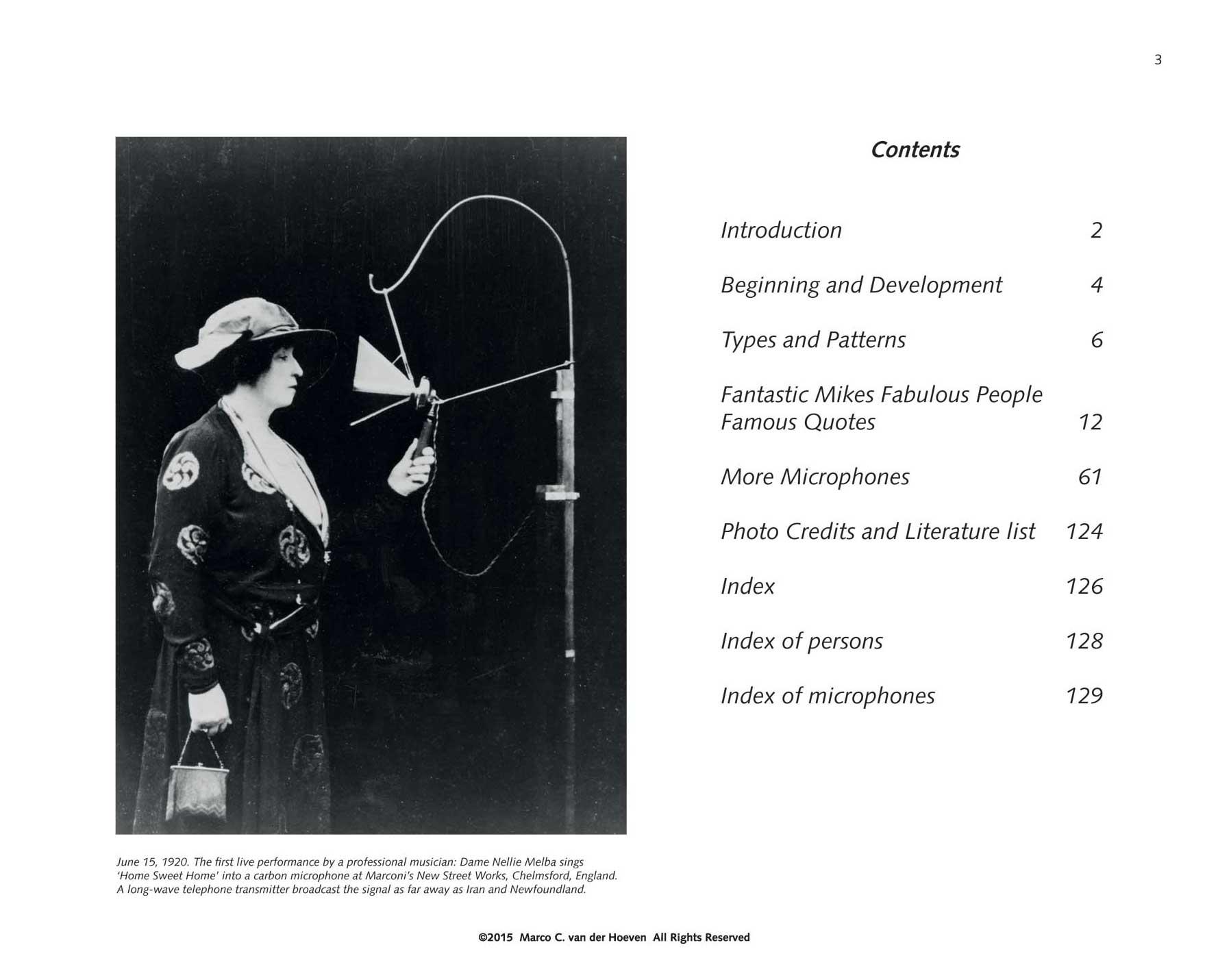
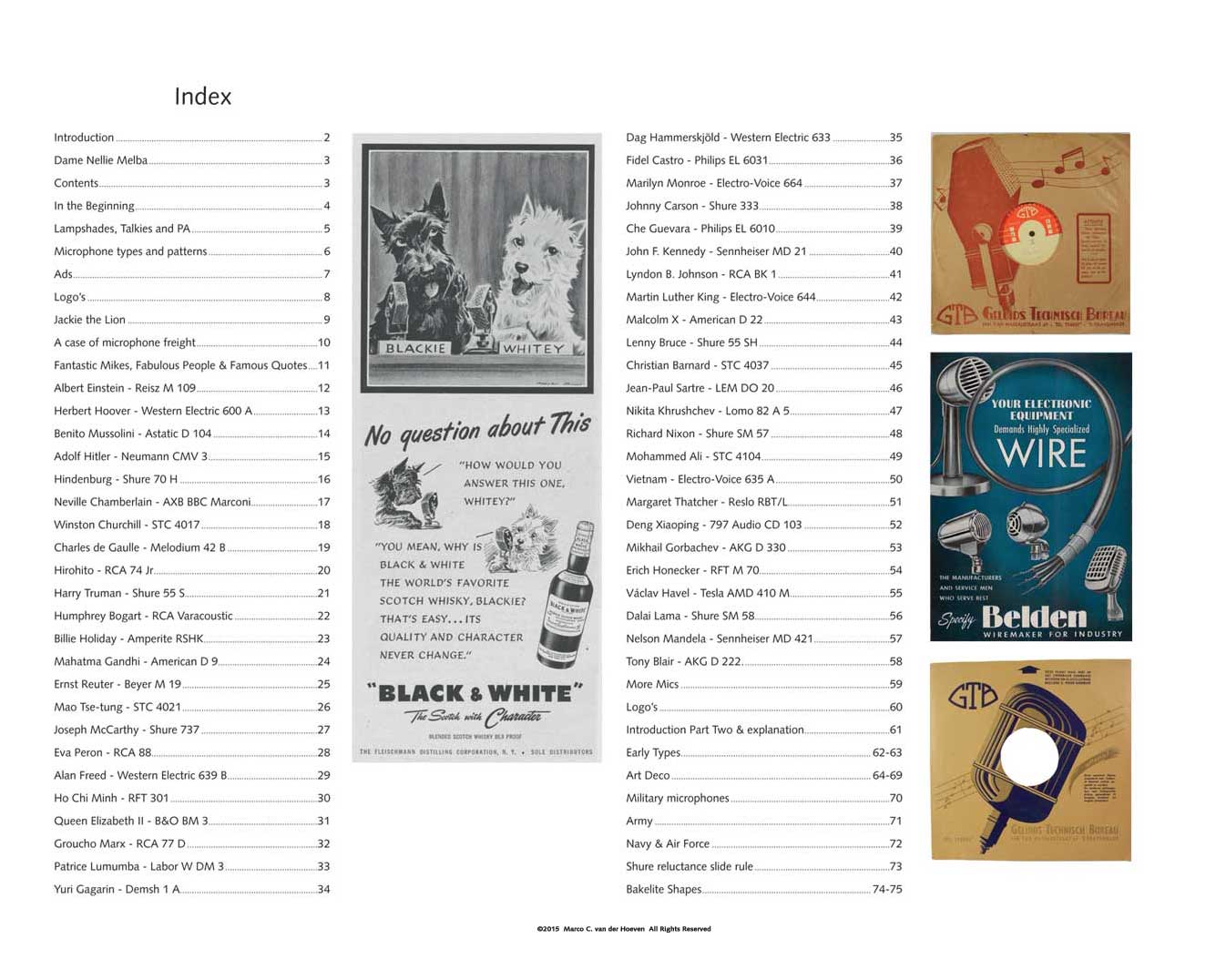
Witnesses of Words by Marco C. van der Hoeven. (Book Review)


This beautiful book arrived in the post last week. There aren't enough good books about the history of microphones, so it was a pleasant surprise to discover that Marco van der Hoeven had written this wonderful volume. Marco is a musician, engineer and historian, and he has a very impressive collection of microphones too.


But Marco's book is much more than a history of the microphones themselves - it is also a potted history of the 20th Century, as witnessed by the microphones of the era. Whenever and wherever a crowd was rallied, a war started or a peace brokered, there was a man or a women addressing the public - with a microphone and some kind of PA system.


A large part of the first half of the book shows how microphones were used by some of history's heroes and villains -  scientists and singers, actors and astronauts, dictators and comedians alike are shown with the current technology.

Marco identifies who used which microphone, and gives little discourses about them and why they did so. Perhaps many readers may already know that Hitler favoured the Neumann bottle-shaped microphones, but here you can also find the microphones used by Mahatma Gandhi, Margaret Thatcher and Marilyn Monroe, amongst many others.


And often the choice of equipment would have made a political statement: for example, Charles de Gaulle is shown addressing a liberated crowd through a Melodium 42B. It was very important for the new leader of a country recently freed from occupation during WW2, to be pictured with a French microphone.

The book is rich in detail, anecdotes and Marco's unique perspective, showing his passion for the history of recording and broadcast, and a wider view of its global context.

All the microphones shown are part of his own impressive collection, which includes everything from rare examples that would be at home in a museum, through recording studio and broadcast classics, to numerous small, cheap microphones that might have been used for amateur radio, taxi ranks and tape recorders.

This reminds us that most people who needed to communicate did not always need a Neumann or AKG recording classic, and had probably never even heard of them!


The latter pages of the book show numerous, diverse examples, along with various microphone-related paraphernalia such as advertising documents, stamps, toys and record sleeves. It is the combination of the social, historical and technical perspectives that makes this book unique. And it would make a great Christmas present for the microphone lover in your life!

Witnesses of Words is available for €27.95 from WitnessesOfWords.com 
2015/11/05

Microphones of the Month: Toshiba type A vs RCA PB144 / 44A

Toshiba are well known for making mid-range consumer electronic equipment. Once upon a time they used to make some fine ribbon microphones too! 

Toshiba A (left) and RCA PB144 ribbon microphones

The microphone on the left is generally know in internet-land as the Toshiba 'Type A', although it is labelled SN-1631. It is a very close copy of the RCA 44A and its relatives. I have been informed by a Japanese expert that this was made under license by RCA, most likely in the post-WW2 era. Having looked carefully at the Type A and compared it to my own RCA PB144 (right), I have no reason to doubt this assertion.


The mics look similar outside - my PB 144 has a film set style hanger mounting, whist the Toshiba has a simple cast yoke, and the grill hole size differs.


Inside the microphones there are many similarities and few differences. Both use three large horseshoe magnets to provide the magnetic field, and and the ribbon dimensions are very close.


Perhaps the biggest difference is that the RCA uses cast pole pieces, whereas in the Japanese version they are milled. This probably reflects the tooling and machinery available at the time. Casting is an expensive process for low quantity products.


Beyond the cosmetics, the Toshiba has a 200 ohm output transformer whereas my PB 144 is a 50 ohm microphone, with these no doubt being in line with the broadcast standards of Japan and USA at that time.

(Thanks to Takayoshi Sumitomo for his expertise) 

2015/11/03

Is the MB301 Cardioid ribbon microphone a Beyer in disguise?

I recently had the opportunity to service a pair of MB301 cardioid ribbon microphones. I had always understood these to be rebranded Beyer M260s with a custom grill, but this is not the case.


The MB301 does use a Beyer pistonic ribbon, but the motor is completely different. The Beyer M260 uses four glued rectangular magnets to make the motor,  but the MB301 employs a single large cast ferrous horseshoe magnet. In this respect it looks more like an RCA BK5 or Oktava ML19.

MB301 (left) and Beyer M260 (right)

I think it more likely that the magnet is taken from the Beyer M320 / M360 models, with different pole pieces, although I have not had the chance to compare these on the bench at the same time. Either way, the MB301 is a microphone in its own right, and not a copy of something else.


Despite the ugly oversized grill, they sound pretty good with plenty of top end and bass, and the big magnets give a stronger output signal than the early M260s.

2015/10/31

Beebs in action: Aria ca Spira by Cordasicula

Thanks to Saro Tribastone for sharing his band Cordasicula's new album Aria ca Spira.


Cordasicula come from south-east Sicily and are inspired by the traditional music of their own island, as well as the southern Italian regions of  Calabria, Campania and Puglia.

Saro explained to me that "all these styles, mainly defined by their rhythm, are coming from those areas where 2500 years ago we had Greek people living there, globally known as Magna Grecia (Big Greece)." Their songs are a mixture of original compositions with some traditional tunes, and collectively they have a beautiful, haunting and slightly melancholic quality.


Many of the instruments were recorded with one of our customised Reslo 'Beeb' ribbon microphones. The Beeb was used to record the Greek Tzouras, violin, cello, double bass and Battente guitar for the album. For those who like technical details, they were tracked through a DAV BG1 preamp and Mytek Stereo 192 ADC converter.  It is nice to hear the Beeb working so well with these traditional acoustic instruments. Here is a photo of the  Pier Paolo Alberghini playing double bass, with the Beeb microphone up close to the sound hole.


Marilena Fede's voice was recorded with an AKG C414B, again using a DAV BG1 preamplifier.


Saro has kindly allowed us to share the Spotify playlist for the album, which should appear below.


2015/10/30

Beebs in Action: Majetone calfskin drum heads


I have said many times before that we have fantastic, creative customers, and it is always nice when someone takes the time to share what they are doing. Sometimes their stories are amazing!

James Yates makes custom hand-made calfskin and vellum drum heads, under the guise of Majetone Industries.

Here's a video clip of James playing his drums and skins, recorded using two of our Reslo 'Beeb' microphones as top & side mics in a Glyn Johns arrangement, along with a CAD M179 in cardioid in front of the kick drum.


I think these really do sound fantastic, with a classic yet contemporary tone. I could imagine these sliding very easily into a mix without need for much processing.

You can find out more at the Majetone Industries website.

Melodium RM6 XLR conversion

It's nice to keep things original, but better to make them usable. Let's face it, the definition of a microphone is 'something that records sound', and not 'a chunk of metal that lives in a box'. :-)


Like many old connectors, it is hard to find good quality used Melodium connectors, so here is a nice simple XLR upgrade for a Melodium RM6.


I removed the base of the microphone and cut off the old connector on the lathe. Then I turned a Neutrik XLR socket to fit into its place.


Solder three wires back in place and this RM6 is now ready to record music!

2015/09/23

MOTM - Unknown French Broadcast microphone

The Microphone of the Month column has been sadly neglected this year, simply because a record number of mics came in for repair, and it has been a challenge to keep up. But some rare and fascinating microphones have passed through the workshop this summer, amongst them this broadcasting beauty from France.


I don't know the make or model of this one and it has no markings or badges on the outside or within, but it looks fantastic. The body is made of two cast metal grills, with a cast yoke.


The connector is an unusual three pin affair, which the owner informs me is a SOCAPEX model which was common in France in the 1960s.* The yoke would sit on a custom mic stand adapter, secured by the thumb wheel.


The motor is nicely machined and uses four large wide U-shaped magnets to provide the field through custom pole pieces.


One quirk of the design is that the magnets must be removed to fit the new ribbon. This takes an extra couple of minutes, and on the plus side this means that one's tools are not pulled by the magnets. Care must be taken to get the magnet polarity right when putting it all back together.


The transformer sits in a (presumably) mumetal can at the base. This one is a 50 ohm model, like most of the Melodium broadcast mics of the era.