Hello!

Xaudia offer microphone re-ribboning and repair services.
Showing posts with label ribbon. Show all posts

2022/11/18

Decca Ribbon Tweeters part 2

Last week I posted about repairing some vintage Decca London ribbon tweeters. I was confident that I had done a good job but was unable to do listening tests in context as I only had the tweeters to play with. These are now back with Andy, their owner, who kindly sent in his impressions and some photos. Overall I think we have done a good job and it's a nice feeling to have helped get these back up and running.

Decca Volt speaker with ribbon tweeter

"The [new] ribbon sounds smooth, crisp and clear with no tizz or distortion. I ran it for a while at different volumes and with different music and it sounds excellent with everything I gave it. It is very close in sound to the original in the other speaker with the soundstage being in the middle and correct. I had to try hard to notice a difference, Bob Marley's Is This Love has some high frequency cow bell drum noises and you could hear they were slightly crisper and louder from the new ribbon. The crossover point in the Volt's is about 1200hz so any imbalance between the two tweeters is easily heard as the singer tends to move off centre.

New ribbon installation at Xaudia

"I think the differences could be classed as being between an old and new ribbon the sound from them is so close. I assume as the new ribbon breaks in it will soften in sound a bit. I am tempted to switch the other new ribbon in as well.

Andy's impressive hi-fi setup.

"Considering the lack of info on the ribbons I thought getting a close match sonically was not good but it's turned out to be very close indeed. It is a huge relief to know that if a ribbon gets damaged again I can get help.

"I am not sure but you might get a lot of interest, when I was trying to find someone to repair my ribbons I came across a huge amount of forum posts on the same issue dating back about 5 years. Nobody had managed to find anyone so in theory there are a lot of ribbons to repair out there."

Thanks to Andy Mcgregor.

2022/11/13

Decca Ribbon Tweeters part 1

Decca London ribbon tweeters with huge transformers.

I have not repaired speakers in the past, but I recently had my arm twisted to look at some vintage Decca London ribbon tweeters. In theory they work in a similar manner to a ribbon microphone and should not present too much of a challenge.... right???? Anyway, it is nice to see something different on the bench and maybe I will learn something in the process.

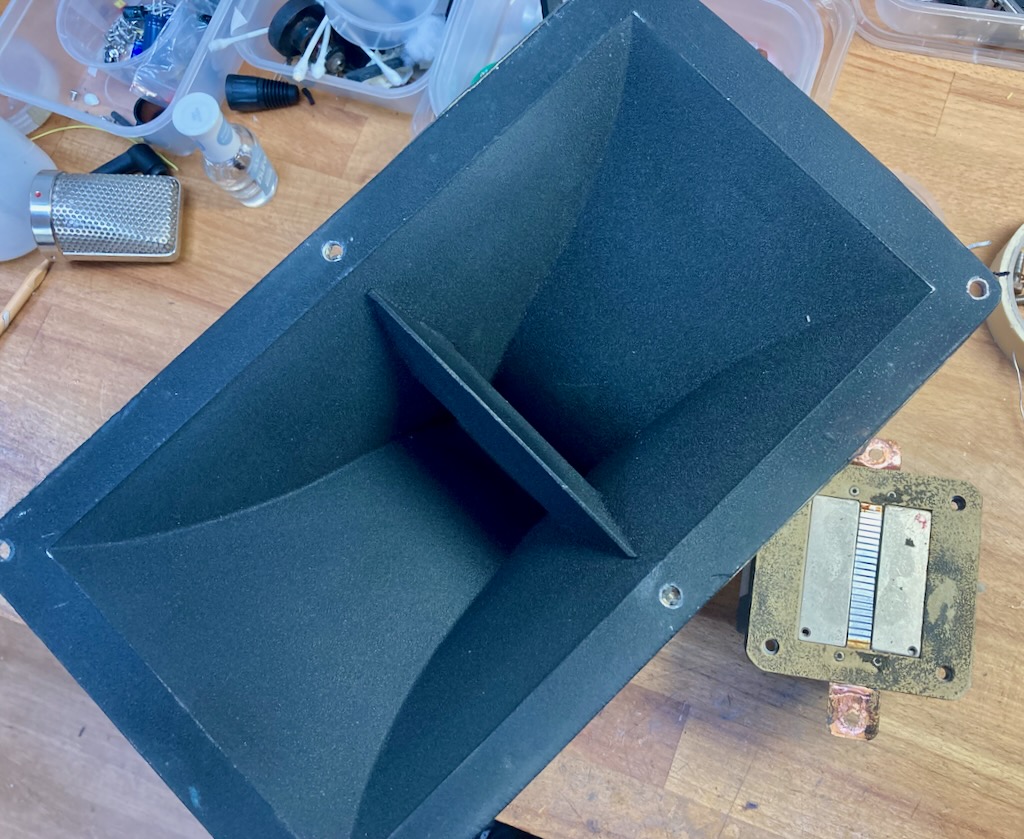
The horn of a Decca ribbon tweeter

The first challenge was to take the speakers apart and work out what is going on inside. They have a large horn with two vents, which is is held in place with six screws. With these out of the way it is possible to remove the large, powerful magnet assembly and ribbon frame.

Brass mess behind the horn,

I received three of these ribbon tweeters but they are not all the same. Two have cast alloy horns and the third had a plastic horn. And the alloy horns have a brass grill that sits in front of the ribbon (shown above), whereas the plastic one has a nylon mesh, which would better protect against incoming metal particles.

These have large, powerful magnets

The ribbon is mounted in a square frame made from two slices of stiff material. All three frames were different and used combinations of cardboard, Tuffnol and what looks to be copper-less circuit board material. Some have silver plated ribbon mounts and others are bare copper.

Old ribbon (left) and new one waiting to be soldered.

The ribbon material in these speakers is stiffer and thicker than one would use in a microphone. The thickest foil I had in stock is 6.5 micrometer thick, supplied by Advent Research Materials, so that is what is going into these. That is about three to four times thicker than would be used in a microphone. The gap is 10mm and I cut the ribbons at 8.6mm, based on measuring a 'good' ribbon. Corrugating is routine, but the challenge here is making the electrical connection from the ribbon to the mounts. There are no ribbon clamps but I can see traces of old solder. 


New ribbon in position.

Soldering thin aluminium needs a special solder and I used Alusol, which worked well after a little practice. All the contacts need to be cleaned before soldering. The solder needs quite a high temperature and you need to work quickly. To make this easier, I lightly glued the ends of the ribbon in place with nail varnish, which helped keep everything aligned. The top layer of the frame are then replaced - I used double sided tape to hold them together, and then the speaker can be re-assembled. 


New ribbon as seen through the horn.

I was only had the tweeters, not the cabs or woofers, and so could not test with full range music. Instead I ran a sign wave through the speakers. They sound clear and without distortion down to about 500 Hz which is a good indicator that I have done a good job. In use they should only be working above about 7 kHz. Now they will go back to the owner for proper testing.

Thanks to Andrew Mcgregor.

Update 18/11/22


Further reading. 

There is an excellent article about Decca ribbon tweeters by Rudolf Bruil at Sound Foundation.

2013/03/03

GEC Ribbon Microphone Evolution

Some time ago I posted about GEC models BCS 2370 and 2373, and how they were essentially the same design in different body shapes for different applications.

Left to right - unknown, unknown. GEC BCS2370 and 2373 mics. All have the same motor.

Since then I have come across some other ribbon microphones which may be earlier GEC models, prototypes. They are perhaps rather ugly in style, but I find their functional utilitarian style rather charming.


The two unbadged mics share some parts including a twinaxial connector at the base and rubber yoke mounts. The mic on the left is made of folded steel, whereas the one on the right is brass, with a more open grill.


All four mics are essentially the same design inside. The mic on the far left has a smaller transformer and different brand of magnet, but the pole pieces and ribbon assembly are the same. The mic in the middle of the photograph above is identical inside to the known GEC mics - with the same magnet and transformer and crumbling plastic ribbon mounts.


Remarkably, both of these mics are still working with a nice tone, although a little noisy. A good clean and service should sort that out.

The mics look very similar to the drawing in a patent by GEC and Thomas Julian, from 1947.

Drawing from a ribbon mic patent by GEC and Thomas Julian, 1947 

Which in turn is obviously inspired by the BBC-Marconi type AX ribbon mic...

Drawing from BBC-Marconi type AX ribbon mic manual.

As an aside, the GEC patent is slightly odd, in that the major innovation is that the pole pieces are held in place by the magnetic field alone, with no mechanical fasteners. That is to say the major innovation is something that they have left out, rather than something they have added to the system. The implication being that other manufacturers MUST use a screw, bolt or other fastener, or else risk infringing the patent.  It would have been interesting to see how that one would stand up in court!

2013/02/09

Altec 670A vs 670B microphones - What's the difference?

Altec 670B (left) and 670A (right) ribbon microphones

Q. What is the difference between Altec 670A and 670B ribbon microphones?

I had not realised that there was a difference until I re-ribboned this 670A for a client, which gave me an opportunity to compare it to our studio 670B. The two microphones look identical from the outside apart from the label. Both are housed in some kind of blue-grey plastic, and the label hides an impedance switch cryptically marked '1' and '2'.

Inside, the mics look similar at first glance, but on close inspection the 'B' model is a significant evolution of the 670A.

The ribbon in the earlier 670A is twice as wide as the later 670B, measuring 3.8mm and 1.9 mm wide respectively. The narrower gap between the magnets would also give a higher magnetic field, although I forgot to measure that.

Altec 670A ribbon and 670B (right) ribbons.

Both ribbons are the same length, so if the same thickness of foil is used, the 670B ribbon would have (about) twice the impedance of the 670A. This has implications for the transformer design, as a different ratio and different inductance would be required.

A second difference is in how the transformer primary wire is routed. In the 670A (left) the thick wire is routed directly behind the ribbon, which would affect the pickup pattern of the mic. This is redesigned in the 670A and passed to the side of the ribbon.

Altec 670A and 670B pattern selectors

Both mics were ready for new ribbons so I replaced both with 1.8 µm foil and measured the impedances (in position 2). The 670A had an impedance of 600Ω whereas the 670B measured 350Ω, which shows that the transformers are indeed different ratios.

It also suggests that the 670A would have originally been fitted with substantially thicker foil - perhaps 4 or 5 µm. The feel and stiffness of the corroded old ribbon also suggests this to be the case.


Here is a frequency plot of the two mics. The 670A is the red line, and the 670B, in blue has a slightly higher overall output. Both mics sound very good and quite similar in tone despite the differences.

2012/09/29

MOTM Reslo SR1 studio ribbon

Reslo SR1 studio ribbon microphone

This month's MOTM is the Reslosound SR1 Studio microphone, which was a big brother to the RB models, and was Reslosound's top of the range ribbon microphone. They are nice sounding figure-8 ribbon microphones, and are very much less common than the RBs, and have become quite desirable amongst collectors and studio engineers. Often they came in a stunning bronze colour with matching plug, like the one above. 


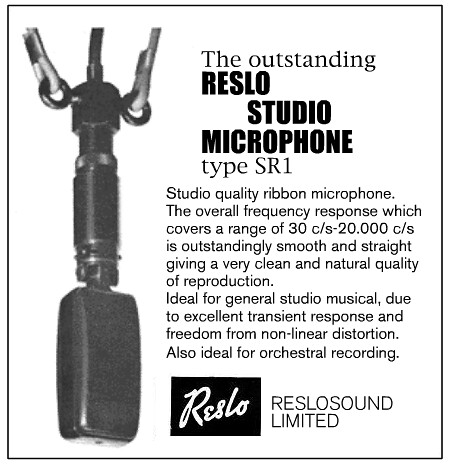
The advertising at the time claimed 30Hz to 20kHz - although doesn't qualify that with a dB range.

Reslo SR1 (top) and RB microphones

Extra sensitivity comes from using a longer ribbon and an extra magnet, and the mic is consequently about 1/3 as long again compared with the more common RB. By necessity the SR uses a different ribbon frame from other Reslo microphones. The mic below came complete with its original fibreglass stuffing -  which protects the ribbon, damps any ringing of the shell, but seems to muffle the sound a little.

Inside the Reslo SR1


Reslo SR1 output connector

The RB microphones are quite notorious for grounding problems, as the mic body is only grounded through mechanical contact at the plug. The SR1 deals with grounding in a better way. The output socket has a hole drilled in the centre with a small wire pushed down and soldered to one of the lugs (see photo, by the green wire). When the mic is reassembled, the long screw that secures the connector makes firm contact with both the mic body and the central wire, giving a good solid ground. This works well, and I now use this approach to ground troublesome Reslo RBs too.

Reslo SR1 transformer, being re-wound

winding arrangement for SR1 transformer

The SR1 was available in both 30/50 ohm and 250 ohm versions, and used the same laminations and bobbin as the later RB transformers, but with a more sophisticated winding configuration. The SR1 transformer has a 5-winding construction, with two primary windings alternating between three secondary windings.

We can supply reproduction SR1 transformers on request.

Thanks to David Pumple for sharing photos and information. The SR1 advert is from http://reslosound.blogspot.co.uk/.

2012/06/27

Beyer ribbon microphone transformer

This transformer came out of a faulty Beyerdynamic M260.

Beyerdynamic M260 transformer

The mic was giving no output, but the ribbon was OK. The problem turned out to be a short in the primary winding, which gave an excuse to take a peek inside.

I was surprised how roughly the primary coil is wound - it really looks like it has been done by hand. Perhaps it is to minimise parasitic capacitance, although that is not usually such a big problem with low impedance windings as they only have a few turns.

In this case the short was located and the original transformer was repaired, but that is not always possible, and sometimes a rewind or replacement is required.

Some of the Beyerdynamic  ribbon mics, such as the M500 and some models of M260 have a 'built in' high pass filter. This is done by manipulating the transformer inductance, allowing some of the bass frequencies to pass to ground. Some people like this, but others (including myself) prefer a full frequency response.

Xaudia B-series (top) and Beyer transformer (below)

Xaudia now produce replacement full-range transformers for repair or upgrade of Beyer and B&O mics. The B-series transformers use a larger core than the originals, but still fit neatly inside the mic. They can be supplied in any desired ratio, and have lower DCR specs than the originals, which gives better noise performance too.

2012/06/08

Upgrade Transformers for Reslos

Those who follow this blog may have noticed a certain amount of Reslo-related activity....

Xaudia R-series transformers - Reslo upgrades & repairs


Our new Reslo upgrade transformers are the result of this work. They are made here in our workshop in York, UK using high quality German laminations and teflon insulated silver plated lead-out wires.

They outperform the original Reslo units in terms of resistance noise and frequency response, giving less noise, an extended bottom end, and better impedance matching into modern equipment.

Typical Characteristics
Primary DC resistance 22 milliohms.
Primary Inductance >620 µH at 1KHz,  >2.0 mH at 100Hz.
Frequency range <20Hz to >65 KHz.
Ratio 1:32 (available in 1:12 to 1:40, as required).

Please get in touch for more information.

2012/05/27

Mystery mic motor

One of our readers sent in these photos of an unidentified ribbon mic motor. It looks like an attempt at a cardioid pattern, with the magnet and transformer located behind the ribbon. Presumably the original mic was a circular, end address arrangement.

If you recognise this or have any further information, we would love to hear from you.


Thanks to David for sending this in.

2012/04/30

MOTM: very old LEM ribbon

April has been hectic! We have been repairing microphones, installing a new coil winder, and developing some new & exciting products. And suddenly it is already the 30th and just time for a very brief MOTM.

This month's mic is a beautiful and very old French LEM ribbon mic, probably from the 1930s....

Very old LEM ribbon mic

Inside, it is very similar to the smaller Amperite ribbon mics, with a large fibreboard frame supporting the ribbon, and a pair of (rather weak) magnets behind.

Old LEM mic deconstructed

The mic has a classic design, with brass sides, a folded steel grill and a cast steel yoke. These solid-sided microphones look strange now, but I guess the thinking at the time was that figure-8 microphones didn't pick up sound (or reflections) from the sides, which allowed for a very simple construction. The ribbon itself is positioned right at the front next to the grill, with a metal plate across the magnets at the rear, so there is some attempt at making the mic more directional.


The transformer had failed due to insulation breakdown, but with new magnets, a fresh ribbon and repaired transformer, the mic has a reasonable output and nice vintage tone. And it looks great!

2012/04/24

Reslo black and red label microphones

Disclaimer
Firstly let me say that this is a study in progress, and should by no means be taken as definitive. Hopefully we will eventually have a big enough data set to be able to speak with confidence, but it will take a while!

Red and black badges on Reslo ribbon mics.

Are black label Reslos better, or even different from red ones?

There is a rumour that occasionally appears on the internet concerning the relative merits of Reslosound RB microphones. Some of the mics have red labels, and others have black ones, which has led to speculation that the mics must be different, and one type must sound better than the other.

Normally it is stated that the black badged ones are better. Most rumours have some basis in fact, so let's investigate!

Reslosound RB microphone dissected

Over the past couple of years I have serviced around 50 Reslo mics, with both colours of badges. Here are some of my empirical observations...

1. The black ones are less common than the red ones, but they are by no means rare. I don't have exact figures but perhaps 75% are red, and 25% black. I will be keeping note from now on!

Edit 29/11/2013: I wanted to correct this figure as I have seen it regurgitated on ebay a couple of times. Having seen a hundred or so more since I wrote this, I really can't say that one is more rare than the other. I would probably guess that they are equally common.

2. There are at least three styles of red badges from different periods.

3. Some later mics (red and black) have a white plastic ribbon holder. The older mics have black bakelite holders. This should not affect the sound.

4. The transformers vary greatly in both looks and specs. This will affect the sound!

So, the only real differences between the red and black label microphones are the transformers (and possibly the state of the ribbons).

Recently, I had seven 30/50 ohm Reslo RB microphones on the bench, and I took the opportunity to examine the transformers. Although the basic construction is the same, the transformers are quite different in looks, and have different inductance values! Some have a striped core with two metals, the middle often being darker or rusty, suggesting a higher iron content. 

Reslo transformers (left to right) A, B, D, E, F

Impedance and resistance values
This is hardly a statistically significant data set, but here goes...

Black labels
A. Lp = 0.463 mH, Rp = 84 mΩ,  Ratio = 1:12, fc = 103 Hz (purple)
B. Lp = 0.434 mH, Rp = 56 mΩ,  Ratio = 1:12, fc = 110 Hz (pink)
C. Lp = 0.470 mH, Rp = 56 mΩ,  Ratio = 1:12, fc = 102Hz
H. Lp = 0.514 mH, Rp = 52 mΩ,  Ratio = 1:12, (purple)
I.   Lp = 0.441 mH, Rp = 45 mΩ,  Ratio = 1:12, (pink)

Red Labels
D. Lp = 0.533 mH, Rp = 52 mΩ,  Ratio = 1:12, fc = 89 Hz
E. Lp = 0.204 mH, Rp = 63 mΩ,  Ratio = 1:13, fc = 234 Hz
F. Lp = 0.214 mH, Rp = 63 mΩ,  Ratio = 1:13, fc = 223 Hz
G. Lp = 0.454 mH, Rp = 49 mΩ,  Ratio = 1:12, fc = 105 Hz

Where Lp is the inductance at 1KHz, and Rp the DC resistance of the primary winding.

The mics are supposed to be 30 to 50 ohms output, and so from the ratio we can estimate the impedance of the ribbon and transformer itself to be around 0.3 ohms. The ribbon impedance and transformer inductance form a high pass filter, and so we can calculate the frequency, fc, at which the bottom end response drops away.* This handy tool means that we don't have to get out our calculators.

* It must be noted that the inductance of a metal core rises and frequency drops, so the cut-off frequencies will in reality be somewhat lower than these values. However, they should be comparable to one another.

What we can say for now, from our very limited data set, is that the three black label transformers, and two of the red ones, have substantially higher inductances and lower cut-off frequencies than the other two red ones. This difference in bass response is likely to be what some users hear as 'better'. However, it cannot be said that a red label mic always has less bass response than a black one.

The two transformers with purple paint have higher values than the ones with pink paint!

My feeling is that the later Reslos have 'better' transformers than the early mics, and that the colour is more cosmetic than diagnostic. But I shall keep adding to this list as more Reslos come into the workshop, and it will be interesting to see what trends develop.

And finally, if you are reading this and once worked for Reslo (or Grampian), we would love to hear from you.


Update 12 May 2012...

In 1961 the BBC R&D group studied the Reslosound RB microphone and recommended that the transformer be replaced with one of higher inductance. It seems plausible that the later Reslos were revised to use a different transformer following that study. You can read the BBC report here.

Stewart Tavener, Xaudia, First posted 24 April 2012, Latest update 12 May 2012

2012/03/25

MOTM: The Australian

This rather lovely RCA44 style ribbon is our microphone of the month for March. He was found on Australian ebay, and so will be known as 'The Australian' until his true identity is discovered!

'The Australian' Vintage RCA style ribbon mic

The mic has a chrome plated steel bottom, a steel yoke, and brass grills, painted black. Connection to the rear is via a pair of screw terminals for balanced output, but with no ground connection.


Although the body shape is very similar to an RCA44, the interior is more like the early Harry Olson prototypes, with a single large horseshoe magnet and broad flat pole pieces, giving a magnetic field strength across the poles of around 1000 Gauss.


The transformer is a dual bobbin type, with a primary inductance of 255 µH at 1 KHz, and 770 µH at 100 Hz. The thick primary wire gives a measured DC resistance of 27 mΩ, and the overall turns ratio is 1:50. With a 2.4 micrometer ribbon, the Australian has an output impedance of about 600 ohms.

There is no maker's name plate, and no sign that there ever was once. However, next to the ribbon there is some writing in pencil. This is a little tricky to capture on film, but it reads "RIBBON 23825 B1154".


Could this be a clue? Perhaps the 23/8/25 is a date from a previous ribbon installation? Sadly, I don't think so. 1925 seems a bit too early - although ribbon mics were invented in the 1920s, the RCA PB31 (first commercial ribbon and forerunner to the RCA44A) wasn't introduced until 1931. It seems more likely that this is a copy or prototype made by a small engineering firm, based around patent drawings.

Sound-wise, the mic has a rich warm tone with a decent output for its age, and the 600 ohm output makes it very usable with modern equipment. The lack of an earth connection makes hum an issue, and I am contemplating adding a third terminal to the rear, if I can find one that matches.

Perhaps it was made by an Australian manufacturer? AWA made copies of RCA microphones, and Zephyr were another Australian company that made some nice ribbon mics. For now it is a bit of a mystery, but we would love to hear from you if you know more about this.

2012/02/25

MOTM - Toshiba ribbon mic

Small Toshiba Ribbon mic

Toshiba are better known these days as a giant manufacturer of consumer electronics goods, so it is perhaps surprising to find a ribbon microphone with their name on. In fact back in the 1960s Toshiba made some pretty decent models, some of which were good copies of RCA mics.


February's microphone of the month is this little ribbon mic, which lacks a model number, but has been referred to as an RCA74b clone. However, although from the outside it resembles a smaller 74b, inside it is very different.


Beneath the outer grills lies a perforated metal baffle backed by a finer mesh screen, which protects the full length of the ribbon against air blasts and pops. The top and bottom of the shield have a tendency to go 'ping' - I could actually hear this ringing when speaking into the mic, so a little bit of sticky foam was used to damp this.

Rear of the Toshiba showing transformer and magnets

From the rear, we can see that the field is suppled by a pair of strong horseshoe magnets glued to the pole pieces, which give a measured field of about 3000 Gauss between the poles. The transformer is a twin core 'humbucking' type, in this case wound for high impedance.

Once the inner screen is removed, two features stand out as unusual. Firstly, there are no ribbon clamps! The ribbon is simply glued to the supports, and then soldered to the terminals. The arrangement works well enough, but you only get one go at fixing the ribbon.

Toshiba ribbon

The second interesting thing is the small cross bar that bridges the pole pieces. This is actually glued to both the pole pieces and the ribbon itself, dividing the 3.6 mm wide, 60 mm long ribbon into two sections in a 3:2 ratio. I can imagine two purposes for this - to stop the long thin ribbon from travelling to far, and to minimise overtones from harmonic motion.

I have also seen this 'node' on another Toshiba ribbon model, so it does seem like a little trick of theirs. The nearest thing I have seen in other microphones is in the Cadenza mics, where the ribbon is glued to a support half way along.

Microphone cleaning

This mic was rather dirty inside. Lots of little bits of iron were interfering with the ribbons movement, making it sound like it was scraping against the sides - which it was! These were easily cleaned with some sticky tape, but the ribbon had to be sacrificed first.

New ribbon in the Toshiba mic

A new ribbon was fitted - soldering 1.8 μm aluminium foil is a bit tricky, but I got the hang of it after a couple of tries. And gluing the cross bar to the ribbon also requires a steady hand!

Once re-ribboned and reassembled (and fitted with a low impedance transformer), the microphone sounds nice, with a relatively flat response up to around 6KHz, where it begins to roll away.

Frequency plot for Toshiba ribbon mic at 35 cm.