A customer asked me to make a mount for his STC 4017 dynamic mic without modifying the microphone itself. Often these come with a handle or a threaded stud for mounting, but this one came with nothing at all.
My first thought was to make some kind of ring clamp, but that would require a large diameter brass tube and was starting to look quite expensive and bulky. So I came up with this…
It is simply a folded strip of aluminium screwed to a threaded brass cylinder. The bass of the cylinder is threaded to fit a 5/8" mic stand. The mic slides into a slot in the aluminium and is held by its own ground clamp.
Some shrink sleeve ensures that the signal outputs are not shorted by the new mount.
Voila!
2014/06/17
2014/06/11
What's inside a Beyerdynamic M260?
This is what happens when one dissects a couple of Beyerdynamic ribbon mics: bodies, grills, motors, transformers, XLR or DIN output connectors. Nothing surprising there….
But what are those grey plastic tubes?
These are in fact acoustic chambers that provide back pressure to the ribbon, changing it from its natural figure-8 pattern towards being hyper-cardioid. It is also critical to the microphone's sound - if you make an M260 without one, it sounds pretty awful.
There is one more important ingredient to the mic, and that is a piece of string. This is stuffed into the chamber to break up internal reflections. Sometimes simple works!
2014/06/10
B&O BM3 ribbon mic - Black Viking edition!
The Black Viking is Xaudia's latest take on the B&O BM3. The vikings came from Denmark and invaded our home town of York, so it seems a fitting name for the mic.
This one has new magnets, new ribbon, a 300 ohm output transformer and XLR output connector. Re-finished in a tough black powder-coating, it is ready for a few more decades of action.
More available soon!
2014/06/07
MOTM Tannoy MD422 cardioid ribbon mic
Here is Tannoy's cardioid ribbon microphone - the MD422.
Firstly, Tannoy lose a point for the name. 'MD' should surely mean "microphone dynamic" in any sensible society! Perhaps the D stands for "directional"? Who knows, but it puts them at odds with other the Sennheiser MD421, and it is just plain confusing.
Whatever the D stands for, the mic itself has an industrial look, and this one is finished in a bronze-ish coloured paint. To the best of my knowledge this is the only cardioid ribbon model that Tannoy ever produced, and it uses an acoustic labyrinth to provide the necessary back pressure to the rear of the ribbon. The chamber is the black cylinder in the photo below.
The MD422 was subject of a BBC technical report, which concluded:"..this microphone has nothing to commend it for use in the Television Service". That assessment seems rather harsh, but at the time the Corporation's selection criteria were flat, uncoloured responses and good signal/noise performance.
In the report, the bi-directional BBC-Marconi AXBT was used as a comparison, which was much more expensive, a different pattern, and therefore a tough benchmark. Cardioid (and non-directional) ribbon mics generally use an acoustic chamber on one side of the ribbon to apply pressure, and this damps the ribbon motion, reducing the output compared with its natural bi-directional response.
Unlike my mic, the BBC's example had a yoke mount rather than a fixed base, although there are mounting screw holes in the side of mine.
Despite my irritation with the model number, and the BBCs damning assessment, I like this microphone very much. It has a gentle warm tone. More importantly, it was an attempt at technical innovation, which is always to be celebrated.
![]() |
| Tannoy MD422 ribbon mic, front |
Firstly, Tannoy lose a point for the name. 'MD' should surely mean "microphone dynamic" in any sensible society! Perhaps the D stands for "directional"? Who knows, but it puts them at odds with other the Sennheiser MD421, and it is just plain confusing.
![]() |
| Tannoy MD422 ribbon mic, rear |
Whatever the D stands for, the mic itself has an industrial look, and this one is finished in a bronze-ish coloured paint. To the best of my knowledge this is the only cardioid ribbon model that Tannoy ever produced, and it uses an acoustic labyrinth to provide the necessary back pressure to the rear of the ribbon. The chamber is the black cylinder in the photo below.
![]() |
| Tannoy MD422 ribbon mic, chamber |
Some of the parts were made to a budget, or perhaps a short production run, with thin stamped metal for the base and top cap, along with two layers of off-the-shelf mesh to protect the mic from dirt and wind.
The ribbon assembly and magnets are the same as found in the type 2 Tannoy 'pitchfork' microphone, which would have saved costs by sharing components.
![]() |
| Tannoy MD422 inside, showing ribbon motor |
The MD422 was subject of a BBC technical report, which concluded:"..this microphone has nothing to commend it for use in the Television Service". That assessment seems rather harsh, but at the time the Corporation's selection criteria were flat, uncoloured responses and good signal/noise performance.
In the report, the bi-directional BBC-Marconi AXBT was used as a comparison, which was much more expensive, a different pattern, and therefore a tough benchmark. Cardioid (and non-directional) ribbon mics generally use an acoustic chamber on one side of the ribbon to apply pressure, and this damps the ribbon motion, reducing the output compared with its natural bi-directional response.
| Drawing of the Tannoy MD422 from BBC technical document. |
Unlike my mic, the BBC's example had a yoke mount rather than a fixed base, although there are mounting screw holes in the side of mine.
Despite my irritation with the model number, and the BBCs damning assessment, I like this microphone very much. It has a gentle warm tone. More importantly, it was an attempt at technical innovation, which is always to be celebrated.
2014/05/27
Reslo MR1 manual
Here is a scan of a 'manual' from 1973 for the Reslo MR1 ribbon microphone, which was the successor to the popular RB model.
2014/05/21
2014/05/17
Reslo Dynamic microphones
Reslo are of course best known for their ribbon microphones, particularly the RV and RV models, However, it should not be forgotten that over the decades they made many dynamic microphones, and even some condensers too.
![]() |
| Reslo VMC with base station |
The earliest Reslo dynamics seem to be the VMC and VMC2, with the initals standing for Velocity Moving Coil. These had a big heavy permanent magnet and a paper diaphragm, and are really rather lo-fi devices. These two models are more or less the same inside, although the VMC was hard-wired, and the VMC2 had a new grill and an output plug.
![]() |
| Reslo VMC2, with output connector. |
In the late 1960s Reslo made a range of more modern light hand-held dynamic mics. The UD1 used a Japanese-made capsule which sounds rather good, of comparable quality to the Shure mics of the era. I have seen transformerless 200 ohm models, and also a dual output 30 & 600 ohm version with a transformer in the body to convert the impedance.
![]() |
| Reslo UD1 microphones |
The UD1 was apparently used by Bob Dylan at the 1969 Isle of Wight festival! Here is an advertisement scan from the Reslosound blogspot….
Some of the UD1 mics were hard-wired to the cable, and it was also supplied with a Reslo connector, and later a 3-pin din plug, with different impedance options available through the different pins. They are wired like this, with one side of the capsule and transformer primary wired to the output socket.
In addition to the UD1, there was a short stubby version that used the same components, and would often have been used with a gooseneck adapter. Pictured below is also a smaller dynamic mic for use with a tie clip.
These models appear to have been replaced in the 1970s by the Reslo Superstar range, which were essentially the UD1 with an updated body and grill. The Superstar was supplied with a DIN plug - I have converted this one to XLR.
![]() |
| Reslo Superstar 80 dynamic mic. |
2014/04/29
Film Industries M5 dynamic microphone
Film Industries Ltd. are perhaps best known for their M8 ribbon microphone, but what about models M1 to M7? Well, here is 14.286 % of the answer: the M5 moving coil microphone.
This model was likely to be a competitor to the Reslosound VMC, and like the Reslo, the M5 features a paper diaphragm driving a moving coil in a magnetic field. The output is wired to a pair of screw terminals, for easy wiring without the need for a custom connector. It does not have a separate ground connection.
The large black rubber cylinder at the base is supposed to give some vibration damping, although perhaps not enough to make a major difference.
Although a 30 ohm mic, this one at least has a strong output, due to the large strong magnets.
And here's a somewhat wiggly frequency sweep of the mic:
This model was likely to be a competitor to the Reslosound VMC, and like the Reslo, the M5 features a paper diaphragm driving a moving coil in a magnetic field. The output is wired to a pair of screw terminals, for easy wiring without the need for a custom connector. It does not have a separate ground connection.
The large black rubber cylinder at the base is supposed to give some vibration damping, although perhaps not enough to make a major difference.
Although a 30 ohm mic, this one at least has a strong output, due to the large strong magnets.
2014/04/21
Reslo Beeb Commando!
Here is a custom edition of our popular ‘Beeb’ modified Reslo ribbon mic. This is the first, and so far the only one we have made in these colours.
The custom camouflage colours makes it suitable for undercover operations, and even better for guitars and drums!
2014/04/16
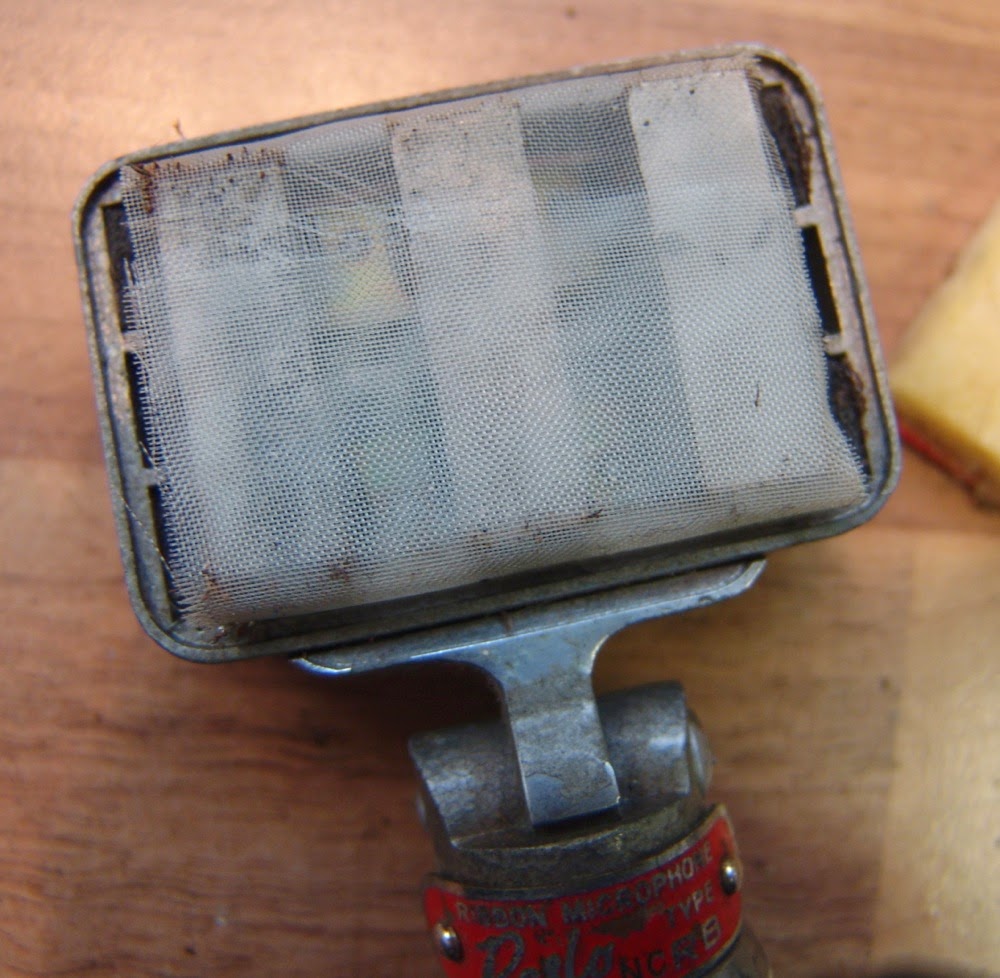
MOTM: Reslo NC-RB Lip microphone
Our Microphone of the Month for April is this rare oddball from Reslosound: the NC-RB.
This was Reslo's attempt at a commentator's lip microphone, and appears to be cobbled together from spare RB parts. The upper body and head are from an RB, but the head is rotated through 90 degrees and screwed to another chopped-down head. The lower body-stroke-handle is a straight aluminium tube with a switch which terminates in a normal Reslo output socket.
Inside the head is a rotated RB-style motor. The magnets face the speaker, to provide some pop protection for the ribbon at the rear.
Behind the ribbon I found this metal baffle, which should control the pickup pattern and tweak the frequency response. There is also fibre glass and felt wadding for more protection.
Overall it is a strange little mic. The ribbon runs horizontally, which is generally considered a bad plan as, if it sags, it will droop into the metal pole pieces. They must have been a way of producing a lip mic without the expense of re-tooling for a completely new design. I have only ever seen this one, although I know of a customer who owns another.
What does NC stand for? "Not a Coles", perhaps?
2014/03/07
2014/03/02
B&O BM5 and BM6 magnet upgrades
A while ago, I blogged about some magnet upgrades for the B&O BM3 and BM4 ribbon mics that greatly improve the signal-to-noise performance of the mics. We have similar magnet upgrades for the later BM5 and BM6 models.
Dirk at V76 Studios in Hamburg was kind enough to share some sound files of his BM5 stereo set, recorded before and after we fitted new magnets and ribbons. Here they are...
'Blackbird' recorded with his stock BM5, before the modifications
Download file
'Blackbird' recorded with the upgraded BM5, with new magnets and ribbons
These are Dirk's impressions of his recordings...
"The difference is amazing. The mic sounds awesome now. It's about 10-12 db louder (needing only 52 db for the front for finger picking now) and it has got much more treble and presence. Still it sounds smooth and wonderful rich, without losing the transients. This mic is killer for acoustic guitar now, and also as a room mic. I also compared it to my modified RB500 Mics (with cinemag 9888 Transformers) and the BM5 now has 6 db more output and is sounding so much better. Also the Beyer M130 doesn't match it by far, IMHO.
"Both were recorded with the BM5 (60 degree angle pointing towards neck and bridge) into a TRP Ribbon Mic Pre direct into RME Converter into my DAW. No lowcut. The older recording would have been 10-12 db lower with the same TRP-Gain. For a better comparison, I choose to normalize both files. Still the new one sounds louder, brighter and more detailed. The noise floor of the older recording is clearly audible, and unnoticable with the new one – due to the 12 db more output of the mic."
Update 21 Feb 2015.
Here are some comments from Andy at Superfly Studios in Nottinghamshire, UK, about his B&O BM5 with magnet upgrades and new ribbons.
"I'm so happy with these microphones. They have been absolutely fab to use over the past few days.
First session in was an acoustic folk duo, I used the B&O BM5 on one of the guitars and it just sat straight into the mix and sounded great. Picked up all the detail of his picking and sounded nice and rounded on the full-on sections. Just the right amount of highs for my taste as well, I normally use a 414 for acoustic and cut some of the top end, but I've got a new favourite now.
Also used the B&O for the drums today and it sounded great in the room, I love using room mics on drums and had the beeb reslo's as a spaced pair about 8 ft away (10ft apart). Seems to always do the trick in the live room and the B&O just in front of the kit at waist hight. Sounded fantastic lovely sustain to the cymbals and picked up the natural ambience of the room."
2014/02/18
MOTM: Gaumont-Kalee Type 1492 ribbon mic
This month's MOTM is the Gaumont-Kalee model 1492,
Inside, the mic is a fairly conventional figure-8 ribbon mic, but has added baffles both sides of the ribbon, and thick wires run from the top ribbon clamp, giving some blast protection along the way.
….made by British Acoustic Films Ltd.
Both GB Kalee Ltd. and BAF Ltd. were subsidiaries of the parent Rank Organisation, which owned various other companies associated with the film industry, including Odeon Cinemas.
Back to the microphone - this specimen comes in a nice wooden box, and although is painted in a rather drab shade of mustard yellow, there is something pleasing about its proportions and utilitarian design. The grill has a coarse outer later and a very fine layer of woven wire inside. It is designed to sit on a boom mount, like this (nicer looking) gold-painted example from Pinewood studios.
Sadly we don't have the mount, but as this shares a connector with the Reslosound mics, we can use a Reslo stand mount for it. None of the other parts are common to the Reslos, so they must have just sourced the connector from them.
Inside, the mic is a fairly conventional figure-8 ribbon mic, but has added baffles both sides of the ribbon, and thick wires run from the top ribbon clamp, giving some blast protection along the way.
The ribbon motor uses tapered triangular pole pieces, which compensate for the decrease in magnetic field with increasing distance away from the two block magents, and ensure a more even magnetism along the length of the ribbon.
And of course there is a suitable transformer in the base to convert to a sensible impedance - in this case 50 ohms. The mic sounds rather nice, rich and dark close up - it may make a vocal session very soon!
2014/02/08
Lustraphone Lustrette - dynamic mic
Here is a little Lustrette LD/61 - a charming little egg-shaped desk microphone by Lustraphone.
I picked this one up with a couple of crystal microphones, and for a long time I had wrongly assumed this to be a crystal too. But when I opened it up I found a dynamic capsule and step-up transformer. I should have guessed from the model number - 'D' usually means dynamic. In fact it features in a Lustraphone product catalogue that I posted earlier - so I have no excuses!
![]() |
| Lustraphone LD/61 inside |
The mic comes in a stylish box, with a picture of the mic, so you know what you're getting.
The dynamic element looks similar to the one found in the more common C51 model, and it is possibly the same mic in a different package.
Subscribe to:
Posts (Atom)